
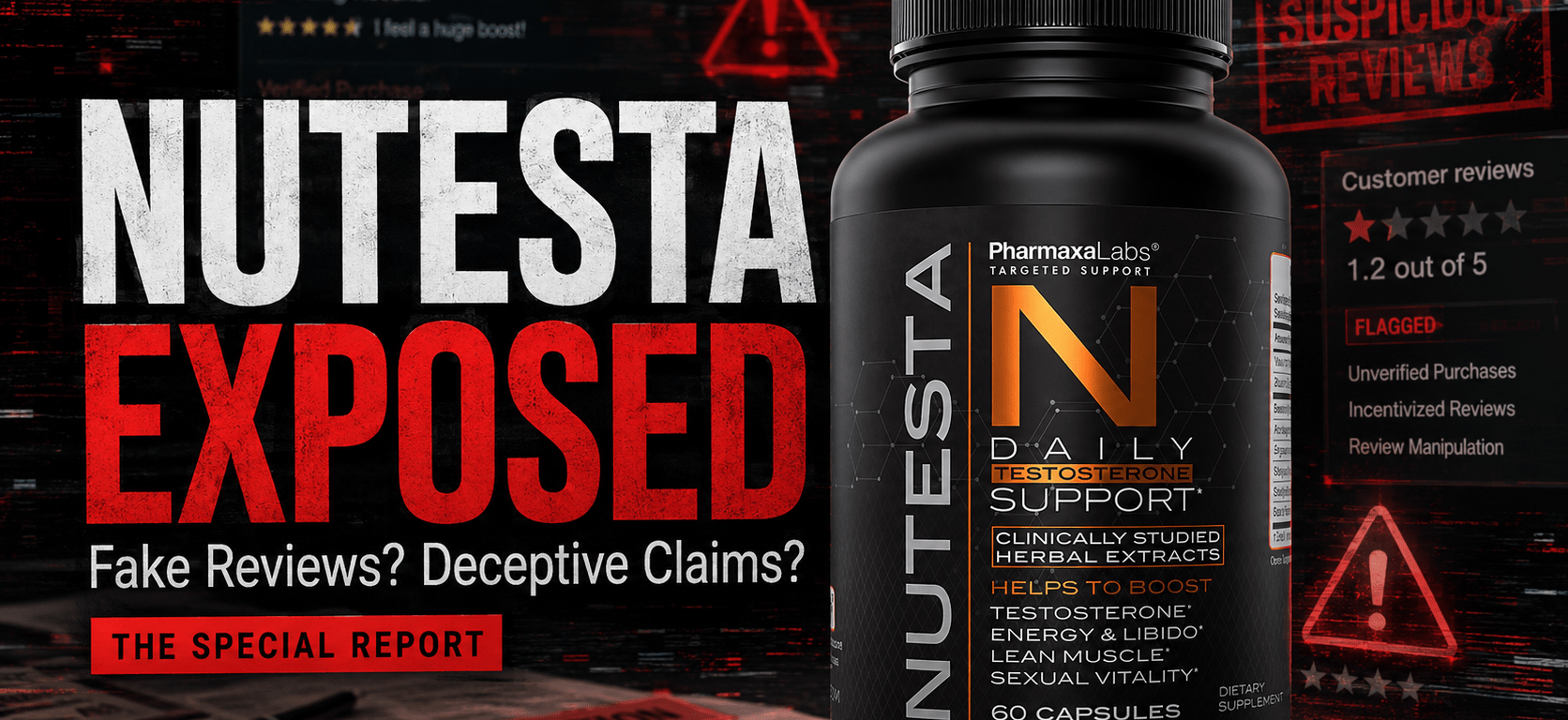
Nutesta Review 2026: The Testosterone Booster Built on a Fake-Review Funnel
By David Harlan, Senior Investigative Editor, Sports Nutrition Journal
Thornton, Colorado • Last Updated: June 27, 2026
This investigation examines Nutesta reviews, the Nutesta testosterone booster, Pharmaxa Labs ownership, HealthWeb Magazine, Total Health Reports, customer complaints, formula red flags, and the coordinated fake-review funnel designed to hijack searches for competing products.
Category: Men’s Health, Testosterone Support, Supplement Reviews
About the Author
David Harlan has spent more than a decade investigating supplement marketing practices, direct-response advertising, and consumer protection issues in men’s health. His work focuses on exposing review-style funnels, undisclosed commercial interests, and overstated claims that mislead men seeking legitimate testosterone support. He is based in Thornton, Colorado.

Bottom line: Nutesta may be a real supplement, but its marketing ecosystem raises serious credibility questions. The biggest red flags are the review-style funnel, commercial conflicts, internal survey claims, inconsistent formula descriptions, refund-policy fine print, and the way Nutesta is positioned through pages that do not look as independent as they first appear.
How We Investigated This Review
We directly examined Nutesta’s official website, HealthWeb Magazine’s Nutesta and Adaptophen pages, Total Health Reports’ Adaptophen-targeted content, Trustpilot customer reviews, and public corporate ownership disclosures. We cross-referenced all marketing claims against current FTC guidance on health product marketing and native advertising. All findings are based on publicly available information as of June 2026.
Key Takeaways from This Nutesta Review
- Multiple review-style pages promoting Nutesta show clear commercial ties to Pharmaxa Labs / All Web Shopping LLC.
- HealthWeb Magazine and Total Health Reports use competitor brand names (including Adaptophen) as traffic bait before pivoting to Nutesta.
- Internal customer survey percentages are presented as near-clinical proof despite explicit disclaimers that they are not clinical studies.
- Formula descriptions vary significantly (8 vs 16 ingredients) across Nutesta’s own site and promotional review pages.
- The “No Fine Print” guarantee contains meaningful restrictions on returns and reorders.
Inside This Nutesta Review
- Nutesta Review: A Testosterone Booster or a Marketing Machine?
- The First Red Flag: Nutesta Is Being Propped Up by Review Pages That Don’t Look Independent
- Follow the Money: All Web Shopping, Pharmaxa Labs, and Nutesta
- HealthWeb Magazine: The “Fact Checked” Review Site That Admits It Does Not Test Products
- The Embarrassing Skincare Error That Says Everything
- Total Health Reports: The Quiet Part Said Out Loud
- The Survey Numbers: Big, Shiny, and Not Clinical Proof
- Ingredient Studies Are Not Product Proof
- The Formula Problem: Eight Ingredients, Sixteen Ingredients, and a Whole Lot of Confusion
- The “100% Safe” Problem
- The FDA-Regulated Facility Halo
- The Guarantee: “No Fine Print” Meets the Fine Print
- The Trustpilot Trail: Positive Score, Strange Details, and Real Complaints
- The Customer Testimonial Trap
- The Nutesta Sales Funnel Knows Exactly Where Men Are Vulnerable
- The “No Subscription” Claim Is Nice — But It Does Not Fix the Bigger Problem
- Is Nutesta a Scam?
- The Adaptophen Hijack: Why This Review Exists
- Nutesta Review Verdict: A Generic Formula Wrapped in an Aggressive Credibility Machine
- A Better Alternative for Men Who Want Real Testosterone Support
- Nutesta Review FAQ
Nutesta Review: A Testosterone Booster or a Marketing Machine?
There are two kinds of men’s supplement brands.
The first kind sells a product and lets the product fight for its reputation.
The second kind builds an entire theater around the product: fake-looking review pages, “top rated” rankings, dramatic percentages, borrowed medical authority, “fact checked” badges, star ratings, polished testimonials, limited-time offers, and comparison articles that just happen to steer the reader toward the same product again and again.
Nutesta looks like the second kind.
On the surface, Nutesta is marketed as a natural testosterone-support supplement for men who want more energy, more drive, better workouts, sharper focus, stronger libido, and a better body. That is familiar territory. Every man over 40 has seen the pitch. You are tired. Your belly is softer than it used to be. Your workouts do not hit the same. Your sex drive is not what it was. You still feel like the same guy inside, but the body is no longer cooperating the way it used to.
That emotional hook is powerful because it is real. Millions of men do feel that slide. The problem is that the supplement industry knows exactly how to exploit it.
Nutesta does not merely sell a bottle of capsules. Nutesta sells a story: that it is the top-rated answer, the smarter choice, the “science-backed” male vitality formula, the testosterone booster other products cannot match.
But when you start pulling at the threads, the story starts to look less like a breakthrough and more like a carefully engineered marketing funnel.
And the deeper you look, the more uncomfortable it gets.
The First Red Flag: Nutesta Is Being Propped Up by Review Pages That Don’t Look Independent
The biggest problem with Nutesta is not that it contains herbs. The biggest problem is the way it is being promoted.
Nutesta shows up inside a web of review-style content that appears designed to create the impression of third-party credibility. These pages do not simply say, “Here is our product, here is why we like it.” That would be advertising. Direct. Clear. Fair.
Instead, the Nutesta ecosystem uses a more slippery play.
A man searches for something else — in this case, Adaptophen — and lands on a page that appears to be an “Adaptophen review.” The page discusses Adaptophen just enough to look relevant. Then it pivots into a “Top Testosterone Boosters” section. And who sits at the top?
Nutesta.
That is the move.
The consumer arrives looking for one brand. The page quietly changes the conversation. The searched brand becomes the bait. Nutesta becomes the destination.
That is not old-school magazine reviewing. That is search hijacking dressed in a lab coat.
The most obvious examples are the HealthWeb Magazine and Total Health Reports pages targeting “ANR Adaptophen Review.” Both pages use Adaptophen as the entry point, then pivot into Nutesta as a top testosterone booster or better alternative. That is not a coincidence. That is funnel architecture.
And it gets worse when you examine who is behind the curtain.
Follow the Money: All Web Shopping, Pharmaxa Labs, and Nutesta
Nutesta is tied to Pharmaxa Labs. Nutesta’s own website says Nutesta is a brand of Pharmaxa Labs and that Nutesta and Pharmaxa Labs are owned and operated by All Web Shopping, LLC.
That matters because Total Health Reports, one of the review-style sites pushing Nutesta on an Adaptophen-targeted page, openly identifies itself as a property of All Web Shopping LLC. On that page, Total Health Reports says it is owned by All Web Shopping LLC and that “we are the manufacturer of Nutesta.”
Read that slowly.
The review page targeting Adaptophen is operated by the same corporate ecosystem that manufactures Nutesta.
That is not a neutral review. That is the seller wearing a reviewer costume.
A real independent review site does not use a competitor’s brand name to attract shoppers, then rank its own product first. A real independent review site does not create the appearance of consumer guidance while operating with a direct financial interest in the “winner.”
That is not consumer advocacy. That is a sales funnel.
And once you see the funnel, it is hard to unsee it.
HealthWeb Magazine: The “Fact Checked” Review Site That Admits It Does Not Test Products
HealthWeb Magazine might be the slickest part of the Nutesta credibility machine because it looks like a health publication. It uses editorial bylines. It uses medical reviewer bios. It uses “Fact Checked.” It uses ratings. It uses careful-looking subheads. It uses the tone of a site trying to sound clinical and objective.
But HealthWeb’s own disclosures undercut the entire performance.
HealthWeb says its reviews are subjective summaries and do not involve product testing whatsoever. It also says readers should assume product links are sales links. Its FTC disclosure says its “Top Products” content is branded advertising marketing content where HealthWeb has a financial interest as owner of the first product listed in the table and as owner and/or promoter of other products listed.
That is not a minor detail. That is the whole story.
If a website tells readers it does not test products, then it should not be treated like Consumer Reports. If a website admits financial interest in the top product, then its rankings should not be treated like independent science. And if that same website gives Nutesta glowing placement while downgrading or questioning competing products, consumers should be skeptical. Very skeptical.
HealthWeb’s Nutesta review gives Nutesta an almost heroic presentation: high rating, “#1 Rated Testosterone Booster Product of The Year,” medically reviewed framing, and glowing language around libido, testosterone, muscle, strength, mood, energy, fat reduction, and overall male performance.
Then, on the Adaptophen-targeted page, HealthWeb does something revealing. It rates Adaptophen, questions it, inserts subjective scoring, and then brings in Nutesta as the preferred alternative.
That is not a neutral review of Adaptophen. That is an Adaptophen doorway into a Nutesta pitch.
The Embarrassing Skincare Error That Says Everything
One of the strangest things found inside the HealthWeb “ANR Adaptophen Review” page is a section about Skin Il Makiage reviews and skincare-serum customer insights.
Stop there.
A testosterone booster review page contains a skincare-serum section.
That is not a tiny typo. That is not a misplaced comma. That is a credibility grenade.
It suggests templated content. It suggests sloppy editing. It suggests a review factory where content blocks may be reused, swapped, inserted, or forgotten. And when a page is labeled “Fact Checked” or medically reviewed, that kind of error is not just embarrassing. It is disqualifying.
If the page cannot keep unrelated skincare testimonials out of a men’s testosterone supplement review, why should anyone trust its Nutesta ranking? Why should anyone trust its Adaptophen rating? Why should anyone trust its “research”?
A medically reviewed, fact-checked page should not look like someone spilled a beauty-serum review into a testosterone article and hit publish anyway. That single mistake tells you more about the review ecosystem than any polished disclaimer ever could.
Total Health Reports: The Quiet Part Said Out Loud
Total Health Reports is even more direct. Its Adaptophen page says it is a property of All Web Shopping LLC. It says Total Health Reports is owned by All Web Shopping LLC. It says the operator is the manufacturer of Nutesta, ranked #1 below.
That is the quiet part said out loud.
The page uses Adaptophen as the hook. It then moves into “Top Testosterone Boosters.” Nutesta is ranked first. Nutesta gets an A+ grade. Nutesta gets dramatic benefit percentages. Nutesta gets “Learn More Now” and “View Offers” links. Nutesta gets the sales path.
The page also uses internal customer response survey percentages, while admitting the survey is subjective and should not be interpreted as a clinical study.
That is the trick in miniature: big bold numbers up front, legal caveat tucked underneath.
The consumer sees “Boosts Testosterone Levels 96%.” The careful reader later sees that the number is based on a subjective internal customer response survey of subgroups and is not a clinical study.
Those are not the same thing.
And no serious man shopping for testosterone support should confuse the two.

The Survey Numbers: Big, Shiny, and Not Clinical Proof
Nutesta’s marketing relies heavily on percentage claims.
On Nutesta.com, the company presents internal customer survey-style results. It says 97% found the product safe and well-tolerated in addition to being highly effective. It says 75% of men reported a positive difference in energy and libido. It says 83% reported improved physical performance and endurance. It says 67% reported improvements in muscle strength.
Then the footnote arrives: the survey is internal, self-reported, results may vary, and it should not be interpreted as a clinical study.
That footnote changes everything.
An internal customer survey is not a testosterone blood test. It is not a randomized, placebo-controlled human trial. It is not blinded. It is not peer reviewed. It is not independent. It does not prove that Nutesta raised testosterone. It does not prove fat loss. It does not prove muscle gain. It does not prove libido changes were caused by the product.
It is marketing feedback.
That does not make every positive review fake. Some men may genuinely like Nutesta. Some may feel better. Some may enjoy the product. But self-reported customer feedback is a very different standard than the kind of clinical evidence implied by phrases like “clinically proven,” “science-backed,” and “real results.”
The problem is not that Nutesta has customer feedback. The problem is that the marketing ecosystem appears to inflate that feedback into a much bigger proof story than it can carry.
By the time the numbers show up on the review pages, the impression becomes even more aggressive. HealthWeb and Total Health Reports use claims like 96% testosterone, 93% libido, 94% energy and athletic performance, 96% muscle mass and metabolism, and 92% positive consumer reviews. That is a lot of precision for a self-reported, non-clinical survey environment.
If a product really increases testosterone by 96%, show the bloodwork. Show the study. Show the baseline testosterone, free testosterone, SHBG, LH, FSH, estradiol, age groups, sample size, placebo control, and statistical analysis.
Do not show a sales table.
Men deserve better than that.
Ingredient Studies Are Not Product Proof
Nutesta’s ingredient story follows a familiar supplement-industry script.
The formula includes recognizable names: Tongkat Ali, Shilajit, Ashwagandha, Stinging Nettle, Zinc, Vitamin D, Black Pepper extract, Boron. These are not obscure ingredients. They show up all over the testosterone-support category.
Some of them have research interest. Ashwagandha has been studied for stress and performance markers. Tongkat Ali has been studied in male vitality contexts. Shilajit has been studied in small human trials. Zinc and Vitamin D matter for men who are deficient.
But that does not prove Nutesta works as advertised.
This is one of the oldest tricks in supplement marketing: cite studies on individual ingredients and let the consumer believe the finished product itself has been proven.
A study on Ashwagandha is not a study on Nutesta.
A study on Tongkat Ali is not a study on Nutesta.
A study on Shilajit is not a study on Nutesta.
A study involving Zinc-deficient men is not proof that a multi-ingredient formula will dramatically raise testosterone in all men.
Dose matters. Extract standardization matters. Baseline health status matters. Deficiency status matters. Study duration matters. Outcome measures matter. The full formula matters.
If Nutesta wants to be treated like a clinically proven product, then Nutesta should produce a finished-product clinical trial. Not ingredient cherry-picking. Not internal surveys. Not testimonials. Not “clinically studied ingredients.” The finished product.
Until then, the honest phrasing is much simpler: Nutesta contains ingredients that have been used in men’s health formulas, but the marketing claims appear to run ahead of the visible finished-product evidence.
That may not fit nicely on a sales banner. But it is closer to the truth.
The Formula Problem: Eight Ingredients, Sixteen Ingredients, and a Whole Lot of Confusion
Nutesta.com describes the product as a targeted blend of eight carefully selected natural ingredients.
HealthWeb’s Nutesta review repeatedly describes Nutesta as containing sixteen potent or clinically supported ingredients.
That is not a minor editorial quirk.
The formula is the product.
If one part of the Nutesta ecosystem says eight ingredients and another says sixteen, the obvious question is: which is it?
Is HealthWeb using outdated copy? Is there another formula? Was the review generated from a template? Did someone fail to update the article? Was the product page changed while the review page stayed frozen in time? Or is the review simply not as carefully researched as it wants readers to believe?
None of those answers inspire confidence.
A serious product review should get the basic formula right. If a review cannot accurately tell readers what is in the product, it has no business declaring the product one of the best testosterone boosters of the year.
That is not nitpicking. That is the minimum standard.
The “100% Safe” Problem
HealthWeb’s Nutesta review says Nutesta is 100% safe and that no adverse side effects have been reported by customers.
That kind of language is reckless.
No responsible review should casually describe a multi-ingredient hormone-support supplement as 100% safe for every man. Men are not lab mannequins. They come with blood pressure issues, sleep apnea, anxiety, prostate concerns, medications, TRT use, SSRIs, stimulants, diabetes drugs, blood thinners, and individual reactions to herbs and minerals.
Natural does not mean risk-free.
Ashwagandha can affect some people’s digestion, sedation, thyroid markers, or mood. Tongkat Ali can feel stimulating to some users. Shilajit quality depends heavily on sourcing and purification. Black Pepper extract can alter absorption. Zinc, Boron, and Vitamin D are dose-dependent. Stinging Nettle may not be appropriate for everyone.
A good men’s health article would talk about nuance.
A sales funnel says “100% safe.”
That difference tells you exactly what kind of content you are reading.
The FDA-Regulated Facility Halo
Nutesta leans on the phrase “Made in FDA-Regulated Facility.” That sounds reassuring. It sounds official. It sounds like a government seal of confidence.
But consumers need to understand what it does not mean.
It does not mean Nutesta is FDA-approved.
It does not mean the FDA confirmed Nutesta raises testosterone.
It does not mean the FDA verified Nutesta’s libido claims.
It does not mean the FDA tested Nutesta before sale.
It does not mean the FDA reviewed the product’s marketing claims and gave them a green light.
Dietary supplements are not approved by the FDA before they are marketed. Manufacturers are responsible for ensuring their products are properly labeled and not adulterated or misbranded. FDA-regulated manufacturing language can be relevant to manufacturing practices, but it is not proof that the finished product works.
This is another supplement-industry trust halo.
Put “FDA” near the claim, let the consumer relax, then hide the real disclaimer in smaller language: these statements have not been evaluated by the Food and Drug Administration.
That is not illegal by itself. But it is a marketing move. And the consumer should recognize it as one.
The Guarantee: “No Fine Print” Meets the Fine Print
Nutesta.com promotes a 60-day money-back guarantee. The sales page says “No Fine Print. No Frustrations. No Hassles.”
Then the fine print arrives.
Nutesta’s own page says only one opened bottle can be returned. Remaining bottles must be sealed and untampered. Shipping and return shipping fees are not included. Refunds are limited to the first order. Reorders represent satisfaction and no refunds apply once a reorder has been placed.
That is fine print.
Again, the issue is not that a company has refund rules. Every company has refund rules. The issue is the contrast between the promise and the mechanics.
The emotional promise is frictionless.
The actual policy is conditional.
That matters because Nutesta pushes multi-bottle packages. A man who buys five bottles may think he has a big safety net. In reality, if he opens more than one bottle, wants shipping refunded, or reorders, he may not have the protection he assumed he had.
“No fine print” is a bold thing to say when the fine print is sitting right there.
The Trustpilot Trail: Positive Score, Strange Details, and Real Complaints
Nutesta has a Trustpilot profile with a 4.2 score and 63 reviews at the time reviewed. That is not terrible on its face. Most reviews are positive.
But the details are more interesting than the score.
Trustpilot notes that it does not fact-check specific claims in reviews. It also notes that Nutesta has no history of asking for reviews and that reviews may not be representative. That does not mean the reviews are fake. It means consumers should not treat the Trustpilot page like a clinical evidence file.
Some reviews are glowing. Others are not.
One Trustpilot reviewer complained that the product had “too many real bad chemicals” and said he could not find the full label with all ingredients before ordering. Another complained about paying extra for two-day delivery and not receiving it when expected. Another said the product was not as effective as hoped. Another commented that the final amount went up despite a supposed discount.
Again, these complaints do not prove Nutesta is universally bad. But they do undercut the polished sales narrative that everyone loves it, everything is easy, and the product is a slam dunk.
More importantly, Trustpilot’s “Written by the company” section describes Nutesta as an “innovative wellness platform” with tools for nutrition, fitness, sleep, mental health, personalized insights, and data privacy. That reads like copy for a health-tech app, not a testosterone capsule. For a supplement brand trying to build trust, that kind of strange company-description mismatch is not exactly confidence-inspiring.
The overall picture is not “every customer hates Nutesta.”
The picture is more subtle and more damning: the public review footprint is relatively small, mixed in places, and nowhere near strong enough to justify the thunderous claims made by the Nutesta-friendly review pages.
The Customer Testimonial Trap
Nutesta uses testimonials the way most direct-response supplement brands use testimonials: to make the buyer imagine himself as the next success story.
The testimonials talk about feeling younger, performing better, having more energy, getting stronger, recovering faster, feeling more confident, and improving in the bedroom. That kind of copy is powerful because it targets the deepest insecurities men rarely say out loud.
But testimonials are not proof.
A man saying he feels better is not the same as a lab-confirmed testosterone increase. A woman saying she has her husband back is not evidence of hormone optimization. A customer saying workouts improved does not prove the supplement caused the change. And a first-name-only testimonial without full identity, medical context, baseline labs, or objective measures is not serious evidence for a testosterone claim.
Testimonials can be real and still be misleading if they create a false impression of typical results.
That is why the FTC warns advertisers not to use dramatic testimonials as a substitute for evidence. If a brand implies that typical buyers can expect dramatic libido, muscle, fat-loss, or testosterone benefits, it needs competent and reliable evidence for those claims.
Nutesta’s public marketing leans hard on testimonials and survey numbers. That should make a serious consumer ask for more proof, not less.
The Nutesta Sales Funnel Knows Exactly Where Men Are Vulnerable
This is where Nutesta’s marketing gets psychologically sharp.
The copy does not just sell testosterone support. It sells reversal. Reclamation. Redemption. The message is not subtle: you can have your body back, your energy back, your libido back, your confidence back, your edge back.
Men in their 40s, 50s, and beyond are vulnerable to that message because the underlying fear is real. Nobody wants to feel like he is fading. Nobody wants to be the guy who used to have drive, used to have stamina, used to look good in a shirt, used to feel dangerous in the gym, used to be wanted.
Nutesta’s funnel presses on all of that.
Then it adds urgency. Limited-time offers. Multi-bottle savings. Free bonus products. “Best value” bundles. “Claim this deal.” “Order now.” “Learn more now.” “View offers.”
That is not accidental. That is direct-response architecture.
The capsule is almost secondary.
The real product is the emotional shove.
The “No Subscription” Claim Is Nice — But It Does Not Fix the Bigger Problem
Nutesta emphasizes one-time purchase and no subscriptions. That is one legitimate positive point. In a supplement industry full of shady autoship traps, a no-subscription checkout can be a meaningful consumer benefit.
But it does not erase the rest of the red flags.
No subscription does not make a review page independent.
No subscription does not prove the product works.
No subscription does not validate internal survey percentages.
No subscription does not resolve the eight-versus-sixteen ingredient confusion.
No subscription does not excuse competitor-branded review funnels.
No subscription does not turn an advertorial into journalism.
It is one decent feature in a much bigger credibility problem.
Is Nutesta a Scam?
The word “scam” gets thrown around too loosely online. So let’s be precise.
We are not saying Nutesta is fake capsules in a fake bottle. We are not saying every customer review is fabricated. We are not saying no man could ever feel better using Nutesta. We are not saying the listed ingredients are automatically useless.
The scam-like behavior is in the marketing ecosystem.
When a supplement is promoted through review-style pages that admit no product testing, disclose commercial interests, use competitor brand names as traffic bait, and then rank the financially connected product first, consumers have every reason to feel manipulated.
When a product leans on internal self-reported surveys while review pages present dramatic percentages that feel far more clinical than the evidence supports, consumers have every reason to be skeptical.
When a site says “No Fine Print” and then lists refund restrictions, consumers have every reason to feel the pitch was sweeter than the policy.
When a “fact checked” review page contains unrelated skincare content, consumers have every reason to question the entire review operation.
So is Nutesta a scam?
In our opinion, Nutesta raises serious scam-like marketing red flags. The product may be real. The problem is that the credibility machine around it looks manufactured.
That distinction matters.
Nutesta’s biggest weakness is not necessarily the bottle. It is the bait.
The Adaptophen Hijack: Why This Review Exists
This article is being published because men searching for legitimate products deserve honest information, not review traps.
Adaptophen has been targeted by review-style pages that use the Adaptophen name in headlines and content, then pivot to Nutesta as the preferred alternative. That is not a clean comparison. That is not a fair head-to-head review. That is not neutral journalism.
That is branded search interception.
A man searching for “Adaptophen review” should not be quietly walked into a Nutesta sales funnel controlled or financially influenced by the same ecosystem that benefits from the Nutesta sale.
If Nutesta wants to compete, compete.
Run a real ad. Publish a transparent comparison. Put the company name up front. Say, “We sell Nutesta and we think it is better than Adaptophen.” Then let consumers evaluate the argument.
But do not dress the sales funnel as independent review journalism and pretend the reader is getting objective consumer protection.
That is the line.
Nutesta’s ecosystem crosses it.
Nutesta Review Verdict: A Generic Formula Wrapped in an Aggressive Credibility Machine
Strip away the badges, the rankings, the survey percentages, the “fact checked” pages, the fake-review funnels, the limited-time offers, and the testosterone theater.
What is left?
A familiar men’s supplement with common ingredients, no obvious finished-product clinical trial presented to support the full sweep of claims, inconsistent ingredient descriptions across the promotional ecosystem, a refund policy more restricted than the front-end sales language implies, a small and mixed public review footprint, and a marketing apparatus that appears far more sophisticated than the formula itself.
That is the blunt truth.
Nutesta may contain ingredients that some men like. It may have satisfied customers. It may be manufactured in a compliant facility. It may avoid subscriptions. It may be a real product.
But the marketing asks for a level of trust the evidence does not deserve.
The best testosterone supplements do not need fake-looking review funnels to win. They do not need to hijack competitor searches. They do not need to bury conflicts behind “fact checked” badges. They do not need internal survey numbers to masquerade as hard proof.
Nutesta’s problem is not that it exists.
Nutesta’s problem is that it is trying too hard to look independently crowned.
And that usually means the crown was bought, built, or borrowed.
A Better Alternative for Men Who Want Real Testosterone Support
If you came here because you were researching Nutesta, slow down before you buy. Read the fine print. Look past the review pages. Ask whether the site recommending Nutesta profits from Nutesta. Ask whether the product was actually tested. Ask whether the ranking is independent. Ask whether the “review” page is really a sales funnel.
And if you landed on Nutesta because a fake-looking “Adaptophen review” page pushed you there, take that as your warning sign.
For men who want a more established testosterone-support formula from the official source, Adaptophen is the better place to start. Adaptophen is not sold through shady fake-review funnels pretending to be independent journalism. It is sold directly through the official TeamANR Store, where shoppers can see the product, the formula, the offer, and the brand behind it without being detoured through a competitor’s bait page.
You can review the official Adaptophen page here:
Looking for a Better Testosterone Support Alternative?
Go directly to the official Adaptophen page for product details, formula information, and current offers. Read our full Adaptophen review here.
Visit the Official Adaptophen WebsiteNutesta wants you to believe the review sites already settled the question.
They did not.
They exposed the game.
Nutesta Review FAQ
What is Nutesta?
Nutesta is a men’s testosterone-support supplement marketed by Pharmaxa Labs. It is promoted for testosterone support, libido, energy, stamina, muscle health, stress balance, recovery, and mental focus.
Who owns Nutesta?
Nutesta’s own website states that Nutesta is a brand of Pharmaxa Labs and that Nutesta and Pharmaxa Labs are owned and operated by All Web Shopping, LLC.
Is Nutesta clinically proven?
Nutesta uses language around clinically studied or science-backed ingredients, but ingredient studies are not the same thing as a finished-product clinical trial on Nutesta itself. We found no convincing finished-product clinical proof in the marketing materials reviewed that validates the full range of Nutesta claims.
Why are Nutesta reviews suspicious?
Some Nutesta reviews may be real customer opinions, but the broader Nutesta review ecosystem is suspicious because HealthWeb and Total Health Reports promote Nutesta through review-style pages while disclosing commercial interests, no product testing, or ownership connections.
Why is the HealthWeb Nutesta review a red flag?
HealthWeb gives Nutesta glowing treatment while its own disclosures say its reviews are subjective and do not involve product testing. Its FTC disclosure also says top-product content can be branded advertising marketing content where HealthWeb has a financial interest in the first listed product.
Why is Total Health Reports a red flag?
Total Health Reports openly says it is owned by All Web Shopping LLC and that All Web Shopping is the manufacturer of Nutesta, ranked #1 on the page. That makes the Nutesta ranking commercially conflicted, not independent.
Does Nutesta have side effects?
Any multi-ingredient supplement can cause unwanted effects in some users. Claims that Nutesta is “100% safe” should be viewed skeptically. Men taking medication or managing health conditions should speak with a qualified healthcare professional before using testosterone-support supplements.
Does “made in an FDA-regulated facility” mean Nutesta is FDA-approved?
No. Dietary supplements are not FDA-approved before marketing. FDA-regulated facility language does not mean FDA has approved Nutesta’s testosterone, libido, muscle, energy, or fat-loss claims.
Is Nutesta better than Adaptophen?
The Nutesta-friendly review pages targeting Adaptophen do not provide a credible, independent basis to conclude Nutesta is better. In our opinion, men who are genuinely interested in Adaptophen should go directly to the official Adaptophen website instead of trusting competitor-controlled review funnels.
Should you buy Nutesta?
Based on the red flags reviewed here — the fake-review funnel, commercial conflicts, internal survey claims, formula inconsistency, refund fine print, and overhyped testosterone marketing — we would not recommend Nutesta.
Red Flag Checklist: Before You Buy Any “Top Rated” Testosterone Booster
- Does the review page admit it does not actually test the products it ranks?
- Does the page (or its parent company) have a direct financial interest in the product it ranks #1?
- Are the dramatic percentage claims based on internal customer surveys rather than published clinical trials on the finished product?
- Does the page use competitor brand names in headlines or content as search bait?
- Does the “No Fine Print” or “60-day guarantee” language match the actual refund policy restrictions?
- Is the formula description consistent across the brand’s official site and the review pages promoting it?
If several of these red flags are present, treat the recommendation with extreme skepticism.
Final Word
Nutesta is not just a testosterone booster.
Nutesta is a case study in how supplement credibility gets manufactured online.
The bottle may be real. The ingredients may be familiar. Some customers may like it. But the review ecosystem around Nutesta is where the trust breaks down.
When a company’s product is promoted through review pages that look independent but disclose commercial interests, no product testing, and direct ownership or promotional ties, the consumer is no longer reading a clean review.
He is walking through a sales tunnel.
That is the real Nutesta review.
Not the star rating.
Not the A+ grade.
Not the 96% claim.
Not the “fact checked” badge.
The real review is the funnel itself.
And the funnel tells you everything you need to know.
Sources and Reader Research Links
This investigation reviewed publicly available disclosures, FTC and FDA guidance on health product marketing, Trustpilot review data, and direct comparison of marketing claims across Nutesta’s official site and third-party review pages. All claims are based on information available as of June 2026.
- Nutesta.com official website
- HealthWeb Magazine Nutesta Review
- HealthWeb Magazine About page
- HealthWeb Magazine FTC disclosure
- HealthWeb Magazine ANR Adaptophen Review page
- Total Health Reports ANR Adaptophen Review page
- Trustpilot Nutesta review page
- FTC Health Products Compliance Guidance
- FTC Native Advertising Guide for Businesses
- FDA Questions and Answers on Dietary Supplements
Transparency Note: Sports Nutrition Journal publishes content about testosterone support supplements, including Adaptophen. We believe readers deserve full transparency when review-style content is commercially influenced. This article was written to expose similar practices used in the promotion of Nutesta.
 Sports Nutrition Journal